
Monday, April 6th, 2026
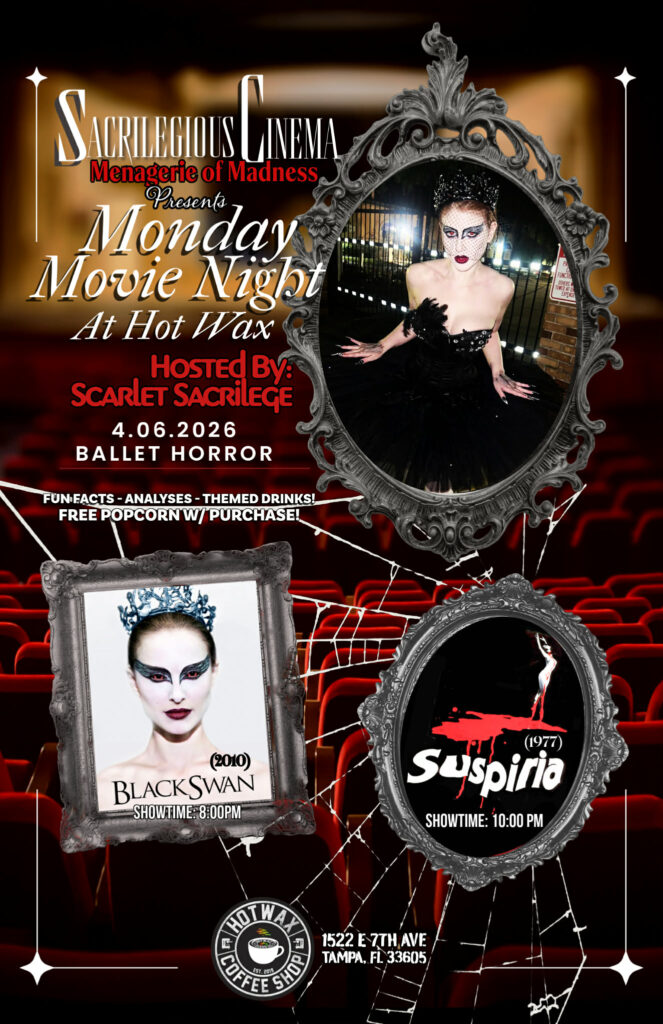
Sacrilegious Cinema: Menagerie of Madness starts the month out strong with a double feature for the dancers, converging two hallucinatory realms colliding into one, representing dual sides of the same coin- therein lies the intersection of the psychological and supernatural, highlighting a hysterical heist into the bowels of lunacy
At 8PM, we journey to New York City and meet Nina- a promising ballerina on the brink of fame that will stop at nothing to gain the leading role in Swan Lake. However, this deadly pursuit of passion causes Nina to plummet into psychosis, plagued by the plight of perfection. Darren Aronofsky’s BLACK SWAN (2010) delivers a fierce psychological case study of a dancer defined by her trade, embracing the role as a master status where identity disappears beneath the obsession, ultimately ushering in an untimely demise and unraveling of her mental health, mangling all that remains.
Black Swan’s expertise lies within duality and the Jungian shadow self, where Nina must present the dichotomy of femininity, imbuing the plot with a Freudian slant echoing the Madonna Whore Complex seated within each archetype she’s expected to embody. This dark double manifests through the other women manufactured as her rivals- between her envy of the seductive Lily, the admiration of “washed-up” ballerina, Beth, and the her mother’s infatuation in living vicariously through her daughter- with Nina’s most formidable adversary presenting as her own shadow, formulating a modern sort of Jekyll and Hyde in her disposition. Moreover, Nina’s rigid repression is aided by her mother’s overbearing oppression- the manipulative matriarch fashioning an insecure attachment style and forging a codependent relationship between the the duo, enacting an arrested development, as she dishes out many forms of abuse towards her offspring out of control, jealousy and unadulterated ownership— quite literally clipping her wings. This haunting metamorphosis coupled with a sexual awakening further fractures Nina’s psyche, splintering aspects of herself into mere shards, reflected by the reoccurring motif of the mirror, accounting for the supplementary symbolism of the swan. Tormented by the standards set for herself, in addition to the societal pressure to appear flawless, she surrenders self-control, her devotion a detriment in the wake of destruction by her own hand. Natalie Portman gives a gut-wrenching performance in her Oscar-winning role as the tragic Nina Sayers, allowing audiences a glimpse into the mind of a paranoid schizophrenic’s lineage into madness, trapping herself not unlike a bird in a gilded cage, her profession all-consuming.
Black Swan takes a page from the playbook of the classic The Red Shoes (1948) in sacrificing oneself for the sake of systematic degradation in honor of artistic dedication. This landmark gem boasts striking cinematography, focusing on monochromatic shades, weaving a visual story through colors and wardrobe, tracking Nina’s mental state throughout its duration. Black Swan details all the hardships of allowing an occupation to overtake identity in striving for perfection, cataloguing mental illness including eating disorders and self-harm- whilst incorporating ageism and sexism rampant in the industry- as well as envy, repression, familial abuse, control, and both the all encompassing Jungian and Freudian dichotomy of self, compartmentalizing the yin and the yang in a multi-faceted union of the disturbed.
Then, at 10PM, we step into a technicolor fever dream and voyage to the esteemed Tanz Akademie in Freiburg, Germany, following American exchange student Suzy Bannion to chase her dream as a ballerina. But when bodies begin to pile up, Suzy suspects foul play, inevitably discovering the school serves as a front for a coven of dangerous witches.
Crafted by the master of macabre, Dario Argento- in arguably his best known film- SUSPIRIA (1977) issues a compelling supernatural horror dressed as a gothic fairytale, setting itself apart from contemporaries in bold execution, emerging with a distinct identity simultaneously defying and revolutionizing cinema as we know it. This experimental genre champion borrows from German Expressionism, drawing inspiration from the architecture of The Cabinet of Dr. Caligari (1920), and reinvents the structures for Suspiria, artfully melding the framework with a vibrant color palette reminiscent of Disney’s Snow White and the Seven Dwarves (1937) to create a kaleidoscopic composition. Excelling in superior cinematography and set design, Suspiria bathes the landscape in lurid hues of red, blue, and green against a vivid backdrop to evoke a visceral reaction from viewers, influencing the narrative with the power of color psychology, reverberating a flair for Poe’s Masque of Red Death. Favoring style over substance, Suspiria plays more as an experience as opposed to a straight-forward story, introducing a mood-driven masterpiece specializing in unnerving theatrics with pulses of energy, demanding audiences to relinquish all logistics to plunge into this surreal nightmare. Featuring a celebrated score by progressive rock band Goblin, Suspiria assaults all senses, accompanying the saturated visuals with discordant sounds, juxtaposing ritualistic chanting with clashing chords to cultivate chaotic ambience. This fusion of fantastical elements allows the film to feel tangible, threading each frame with a feeling of impending doom, looming in gem-toned shadows of the screen. Suspiria earns its position as a classic horror picture, with its reputation of intense otherworldliness nowhere near an exaggeration- cementing itself as the most popular genre entry from the depths of Italy, ensnaring audiences in their spell.
This is a non-negotiable must see for fans of the phantasmagorical— at Hot Wax Coffee Shop in Ybor City.
FREE popcorn included with a mandatory purchase- no cover charge with a 1 drink (or snack) minimum from the bar. (Movie nights offer psychological insight accompanied by behind the scenes information and observations by your horror hostess).